
Search “what do BCAAs do?” and you usually get one of two answers.
The first sounds like supplement marketing: BCAAs build muscle, speed recovery and stop muscle breakdown.
The second sounds like internet backlash: BCAAs are useless, a waste of money and do absolutely nothing.
After reviewing the human research, we think both answers are too easy.
BCAAs are real. Leucine, isoleucine and valine are three essential amino acids. Leucine plays an important signaling role in the muscle-protein response. In a controlled post-workout study, BCAAs alone increased myofibrillar muscle protein synthesis compared with placebo.
So “BCAAs do nothing” is not an accurate summary.
But that finding leads to a second question — and this is where the buying decision gets more interesting.
If BCAAs can activate part of the muscle-protein response, what else does the body still need for that response to be meaningfully supported?
BCAAs are real and biologically active. The buying question is whether three amino acids are the whole job you want the product to do.
That distinction changes the question from “Do BCAAs work?” to a more useful one:
“If I am deliberately paying for amino acids, what exactly am I buying — and how much of the amino-acid picture does the formula actually cover?”
That is the question most buyers should answer before deciding whether a BCAA product is worth the money.
The rest of this report explains why that last question changes the way BCAA-only products look next to broader amino-acid formulas.
01WHAT BCAAs ACTUALLY ARE
BCAA stands for branched-chain amino acids.
There are three: leucine, isoleucine and valine.
All three are essential amino acids, meaning the body cannot make enough of them on its own and they must come from the diet.
They are not obscure compounds found only in supplements. They are already present in complete protein foods and protein powders. Meat, dairy, eggs, soy and whey all naturally provide BCAAs alongside other amino acids.
That point matters immediately.
When someone buys a BCAA product, they are isolating three amino acids from a much larger protein-building system.
Leucine is the star because it can act as a strong signal in pathways involved in muscle protein synthesis. That signaling role is real and helps explain why BCAA products became so popular.
But a signal is not the same thing as a complete supply chain. You can turn on the construction lights. You still need the materials to build.

02The Study That Makes the BCAA Debate Much More Interesting
One of the most useful human studies on BCAAs did not prove that they were useless. It proved something more commercially important.
Researchers gave resistance-trained men 5.6 grams of BCAAs after resistance exercise and compared the response with placebo.
The BCAA drink increased myofibrillar muscle protein synthesis by about 22% versus placebo over the measured recovery period.
That is a real response.
But the authors also noted that the magnitude of the response was roughly 50% lower than myofibrillar protein-synthesis responses previously reported after whey protein containing a similar amount of BCAAs.
Why would three amino acids flip part of the anabolic signal but still produce a smaller response than a complete protein source?
The researchers pointed to a straightforward explanation: the availability of the other essential amino acids can become rate-limiting.
That is the detail that changes the buying decision.
BCAA marketing often focuses on the switch. The physiology still needs the building blocks.
03The Hidden Mistake: Confusing a Signal with a Complete Solution
Leucine deserves its reputation as an important anabolic signal.
But muscle protein is not made of leucine alone.
The International Society of Sports Nutrition’s 2023 position stand on essential amino acids makes the distinction clearly: individual amino acids or groups of amino acids can initiate the stimulatory process, but significant and sustained stimulation of muscle protein synthesis occurs when all essential amino acids are available.
That gives us a simple buyer’s rule:
If the goal is to support the protein-building process, do not judge an amino-acid product only by how loudly it advertises leucine. Judge the whole amino-acid profile.
A BCAA label may be perfectly accurate and still leave the buyer with an incomplete mental picture.
“Contains leucine” is not the same claim as “provides the broader amino-acid pool needed to build complete protein.”
The first can be true while the second remains unanswered.
04SO ARE BCAAs GOOD FOR ANYTHING?
Yes — and pretending otherwise weakens the case.
BCAAs have three defensible reasons people may care about them.
First, they are essential amino acids and part of normal dietary protein.
Second, leucine and the BCAA group participate in signaling and substrate availability related to muscle protein metabolism.
Third, exercise-recovery research suggests BCAA supplementation may reduce delayed-onset muscle soreness and some markers of muscle damage under certain conditions.
A 2024 systematic review and meta-analysis of randomized trials found BCAA supplementation reduced muscle soreness from 24 to 96 hours after exercise-induced muscle damage and lowered creatine kinase at some time points. It did not improve every measured marker, and results varied with study design, dose, training status and other factors.
That makes “BCAAs are useless” a poor summary.
But it does not rescue the bigger marketing leap.
Helping with soreness is not the same as being a complete muscle-building nutrition strategy. Triggering part of the protein-synthesis response is not the same as supplying the broader amino-acid availability involved in sustained synthesis.
The product still has to be judged against the job you want it to do.
05THE QUESTION “ARE BCAAs WORTH IT?” HAS THREE DIFFERENT ANSWERS
Answer AYou already eat plenty of complete protein.
If your diet already includes adequate high-quality protein, you are already consuming BCAAs together with the other amino acids present in those foods. In that situation, an isolated BCAA product may be adding three amino acids to a pool that is already well supplied. That does not make the supplement automatically worthless. It does mean you should ask what additional problem the product is solving.
Answer BYou are under-eating total protein.
If the real gap is simply not consuming enough protein, a complete protein food or protein powder may solve a larger problem than a BCAA-only supplement. Three amino acids should not become an excuse to ignore the rest of the diet.
Answer CYou specifically want a compact amino-acid supplement.
Now the comparison changes. If you are intentionally choosing a low-volume amino-acid format instead of another full meal or shake, then it makes sense to compare the breadth of the formula — not only whether leucine is present. This is where BCAA-only products become much easier to challenge.
06The “Three-amino-acid” Test
Before buying any BCAA or amino-acid supplement, ask six questions.
Question 1How many amino acids am I actually getting?
A BCAA product gives you three by definition. A broader amino-acid formula may give you more. Do not let a large number on the front of the label distract from the actual ingredient list.
Question 2Is the product meant to replace protein, or complement a protein-conscious diet?
A BCAA or compact amino-acid formula should not be marketed as if a few grams automatically replace adequate dietary protein.
Question 3Is my goal muscle-building nutrition, recovery, convenience, or simply a flavored workout drink?
Those are different jobs. A product that is reasonable for one can be a poor fit for another.
Question 4Am I already getting BCAAs from food or whey?
If yes, the incremental value of adding isolated BCAAs deserves more scrutiny.
Question 5If I am choosing an amino-acid supplement, why stop the comparison at three?
This is the question most BCAA category pages never force the buyer to ask.
Question 6Does the company show the actual label, serving size, current offer, guarantee and verifiable buyer feedback?
Amino-acid marketing can become abstract very quickly. The label brings the decision back to reality.
07Side-by-side: What Each Format Is Actually Built to Do
The categories are not interchangeable. The point of the comparison is to match the format to the job — then judge whether the label supports the story being sold.
| Format | What it does best | Main advantage | Main limitation |
|---|---|---|---|
| BCAA-only product | Delivers leucine, isoleucine and valine | Simple, low-volume, familiar amino-acid format | Only three amino acids; can be mistaken for a broader protein-building solution |
| Whey / complete protein | Adds substantial high-quality protein and all nine EAAs | Efficient way to increase total protein | Still another shake or mixed serving |
| Full nine-EAA formula | Compact delivery of all nine essential amino acids | Complete EAA set in low-volume form | Dose, taste, price and evidence vary by product |
| Broader non-protein amino-acid formula | Delivers more amino acids than BCAA-only without a full protein serving | Broader profile plus compact delivery | “Broader” does not automatically mean “complete” |
The decision point becomes simple: if you need more protein, buy protein. If you are specifically shopping for a compact amino-acid product, compare more than the three BCAAs.
08When We Applied That Test, One Formula Became Much More Interesting
At this point, we stopped asking whether BCAAs “work.”
We asked a more useful commercial question:
If someone already wants a compact amino-acid supplement, which established option gives them a materially broader amino-acid profile than BCAA-only without forcing another shake or full serving of protein?
That search led us to Advanced Amino Formula from Advanced Bionutritionals.
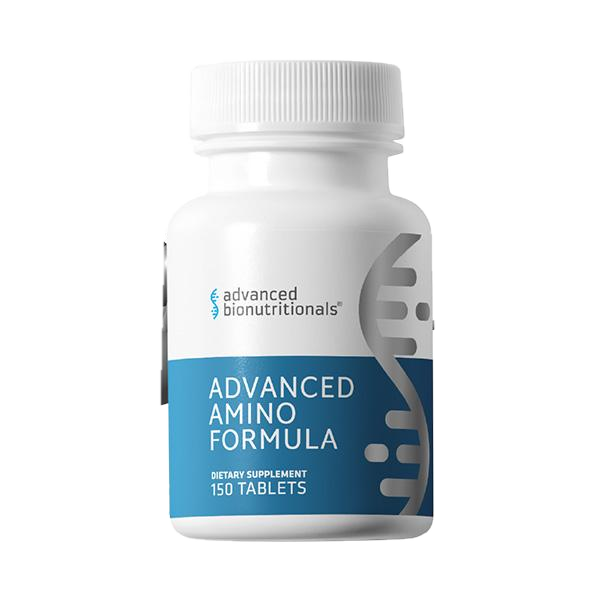 Compact tablet format
Advanced Amino Formula
A broader-than-BCAA amino-acid blend in a five-tablet format designed for buyers who do not want another shake or meal-sized serving.
- 5tablets
- 5,000 mgtotal amino acids
- 8listed amino acids
The current label does not list histidine, so this report does not present the formula as a complete nine-EAA product.
View the current formula and official offerThe current manufacturer label lists five tablets per serving and 5,000 mg of eight amino acids.
Inspect the current label before you decide
The label shown here is a reference image. Check the current manufacturer page for the latest formulation and serving details.
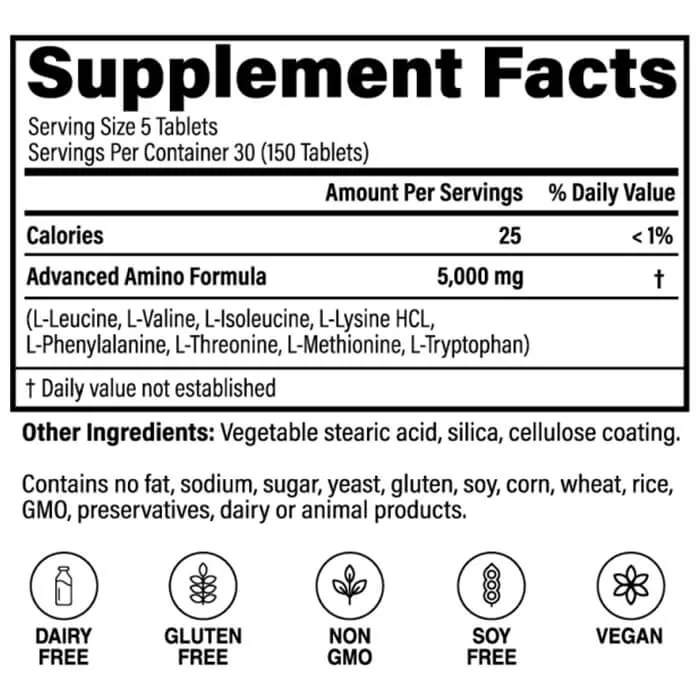
That does not make it a complete protein. It also does not make it a complete nine-essential-amino-acid formula. The current label does not list histidine, which standard nutrition references recognize as an essential amino acid.
We are not going to hide that point to make the comparison easier.
But for someone already shopping in the amino-acid category, the same label creates a direct advantage over a BCAA-only product:
Three amino acids versus eight listed amino acids. Same basic idea of compact amino-acid delivery — but a materially broader label.
No shaker bottle.
No sweet workout drink.
No extra meal-sized food volume.
Five tablets per serving.
For someone already committed to buying amino acids rather than another protein shake, stopping the comparison at three becomes increasingly difficult to justify.
What Advanced Amino Formula actually offers
Why It Rose to the Top of This BCAA-education Comparison
- It answers the biggest weakness of BCAA-only products directly: amino-acid breadth.
- The tablet format preserves the main reason many people buy amino-acid products in the first place — convenience.
- It avoids forcing the buyer back into a full shake when the buyer specifically wants a compact format.
- The label is visible and specific enough to evaluate without relying only on slogans.
- The product has an established manufacturer-hosted review base rather than a handful of anonymous testimonials.
- The manufacturer-advertised 90-day refund window reduces the risk of testing whether the format fits the buyer’s routine.
Eight is not “magically perfect.” But once you stop pretending three amino acids are the entire conversation, a broader formula becomes much harder to ignore.
THE SIMPLEST HEAD-TO-HEAD FOR SOMEONE ALREADY CONSIDERING BCAAs
| Buying criterion | Typical BCAA-only formula | Advanced Amino FormulaBest fit for compact use case |
|---|---|---|
| Amino acids listed | 3 | 8 |
| Leucine | Yes | Yes |
| Isoleucine | Yes | Yes |
| Valine | Yes | Yes |
| Amino acids beyond the BCAAs | No | Yes |
| Compact, shake-free format | Often | Yes — 5 tablets |
| Total amino acids stated on current label | Varies | 5,000 mg per serving |
| Manufacturer-advertised refund window | Varies | 90 days |
If you were already about to pay for amino acids, this is the comparison that matters most: why stop at three before you inspect what a broader compact formula offers?
Risk reversal: the manufacturer currently advertises a 90-day refund window. Review the live terms before purchase because policies can change.
09What Buyers Report
At the time of the manufacturer page reviewed for this report, the manufacturer displayed 3,144 customer reviews, a 4.1 out of 5 average rating and an 81% recommendation rate for Advanced Amino Formula.
That does not prove muscle gain, recovery or any other clinical outcome.
It does provide useful commercial context: this is an established product with enough buyers to generate a meaningful volume of public feedback.
Customer review“I’m feeling strong again.”
Patricia W.Reported returning to the formula after trying another product.
Customer review“Great for being active!”
Ferris K.Age 70; reported weights, swimming, cycling and table tennis.
Customer review“Felt a difference right away.”
Angel N.Reported regular use and an early subjective difference.
Individual reviews are anecdotal and should be treated as buyer feedback, not as guarantees of a typical physiological result.
10Who Is Most Likely to Appreciate This Format
More Likely to Fit
- Someone who has been considering BCAAs but wants a broader amino-acid profile.
- Someone who already understands that food and adequate protein remain foundational.
- Someone who wants amino acids without another shake, flavored powder or large serving.
- Someone whose main reasons for supplementing are convenience, travel or avoiding shake fatigue.
- Someone who values a longer refund window while deciding whether a tablet routine is worth keeping.
This Probably Isn’t for You If…
- You are simply under-eating total protein and need to fix that larger gap first.
- Your top requirement is a verified complete nine-essential-amino-acid formula.
- You expect an amino-acid supplement to replace resistance training or a sufficient diet.
11The Objections That Actually Matter
Do BCAAs work?
They can do something. Human research shows BCAA ingestion can increase post-exercise myofibrillar protein synthesis versus placebo, and recovery research suggests possible reductions in soreness and some muscle-damage markers. The issue is not zero activity. The issue is whether three amino acids are the broadest solution for the job you are paying the supplement to do.
Are BCAAs worth it?
That depends on the job. If your target is soreness/recovery, there is some supportive evidence. If you are simply short on protein, buy protein. But if you specifically want a compact amino-acid supplement, it is hard to justify stopping the comparison at three without at least looking at broader formulas.
Why not just use whey?
If you need more total protein, whey may be the better tool. The problem with whey is not that it is bad. It is that it solves a different problem. Advanced Amino Formula becomes relevant when the buyer wants compact amino-acid delivery instead of another full protein shake.
Why is eight amino acids better than three?
More amino acids does not automatically make a product better for every possible goal. But if you are deliberately buying amino acids because you want broader muscle-building support than a flavored workout drink, an eight-amino-acid label materially changes the comparison. It covers more of the amino-acid profile while preserving the compact format.
Why not buy a full nine-EAA formula instead?
If your only buying criterion is checking all nine essential-amino-acid boxes, compare verified nine-EAA products. But that is not the only real-world criterion. Format, convenience, product history, label transparency and whether you will actually use the product consistently still matter. Advanced Amino Formula earns its place because it combines a broader-than-BCAA label with five-tablet convenience, an established buyer base and a manufacturer-advertised 90-day refund window.
Does Advanced Amino Formula build muscle?
The studies cited in this report did not test Advanced Amino Formula. We therefore do not present them as proof that this product produces a specific muscle outcome. Resistance training, adequate dietary protein and the overall diet remain central.
What does the 90-day guarantee mean?
The manufacturer currently advertises a 90-day refund policy. Buyers should inspect the live terms because policies, shipping details and offer conditions can change.
Bottom line
The BCAA debate is usually framed as a fight between two slogans:
“BCAAs build muscle.”
“BCAAs are useless.”
The research supports a more useful conclusion.
BCAAs are biologically relevant. Leucine is an important signal. BCAA ingestion can influence post-exercise muscle protein synthesis and may help with soreness in some exercise settings.
But three amino acids are still three amino acids.
If your real goal is to increase total protein, a complete protein source may be the smarter purchase.
If your real goal is specifically a compact amino-acid supplement, then stopping the comparison at leucine, isoleucine and valine makes less sense.
That is where Advanced Amino Formula becomes the more compelling option we reviewed.
For a buyer attracted to BCAAs because they want amino acids without another protein shake, Advanced Amino Formula keeps the convenience while expanding the label from three amino acids to eight.
So if BCAAs were already on your shopping list, the question is no longer whether three amino acids can do something. The question is why you would stop the comparison at three when a broader compact option is sitting right next to them.
It is not a complete nine-EAA formula. It is not a replacement for adequate protein. It is not a shortcut around training.
It is a broader, tablet-based amino-acid option with a visible label, an established manufacturer-hosted review base and a manufacturer-advertised 90-day refund window.
If you were already about to buy BCAAs, that is enough reason to compare the label before you stop at three.
Sources reviewed
- Jackman et al., 2017 — Branched-Chain Amino Acid Ingestion Stimulates Muscle Myofibrillar Protein Synthesis following Resistance Exercise in Humans
- International Society of Sports Nutrition, 2023 — Position Stand: Essential Amino Acid Supplementation on Skeletal Muscle and Performance
- Salem et al., 2024 — BCAA supplementation, muscle soreness and muscle-damage biomarkers: systematic review and meta-analysis
- Volpi et al., 2003 — Essential amino acids and muscle protein anabolism in healthy older adults
- Advanced Amino Formula — manufacturer product and offer page