
Search for “best protein for seniors” and the advice starts to sound almost identical: eat more eggs, more yogurt, more chicken, more fish — or add a protein shake.
None of that is bad advice. In fact, for some people it is exactly the right answer.
But after reviewing the research on protein needs in older adults, anabolic resistance, whey, branched-chain amino acids and essential-amino-acid supplementation, we found a problem with the way most comparisons are framed.
They ask which option has the biggest protein number.
That is not always the most useful question.
After digestion, dietary protein is broken down into amino acids. Muscle protein synthesis depends on the amino acids that become available — including essential amino acids the body cannot make in sufficient amounts on its own. Total protein still matters enormously. But the number on the front of the package is only one part of the decision.
The better question after 60 is: what is the simplest, most repeatable way to deliver enough high-quality protein and the amino acids your body needs — without turning nutrition into a second job?
The “best” option changes when the bottleneck changes.
That shift in the question changes how whole food, whey, BCAAs and free-form amino-acid formulas look side by side.
The rest of this guide explains why that last distinction can matter more than it first appears.
01After 60, the Margin for Error Gets Smaller
Muscle does not suddenly stop responding because someone turns 60. Older adults can still become stronger and can still build or preserve lean tissue, especially when resistance training is part of the plan.
What changes is the margin for error.
Researchers use the term “anabolic resistance” to describe, in part, a reduced muscle-protein response to feeding in older adults compared with younger adults. Recent evidence suggests the average difference is real but modest, while the response to resistance exercise is often preserved.
In plain English: older muscle is not “dead.” It may simply reward a more deliberate training-and-nutrition strategy.
That is one reason expert groups have argued that many healthy adults over 65 may benefit from protein intakes above the old minimum allowance, often around 1.0–1.2 grams per kilogram of body weight per day, with higher intakes sometimes discussed for active adults or certain health situations.
The practical message is not “drink the biggest shake you can find.” It is this:
You need enough total protein. You need the right amino-acid building blocks. And you need a routine you can actually repeat.

02The Hidden Mistake: Shopping by Grams Alone
A chicken breast, eggs, Greek yogurt, tofu and a scoop of whey look completely different before you eat them.
After digestion, their proteins are broken down into amino acids.
That is the “aha” most package comparisons never explain. The label shows grams of protein. Muscle protein synthesis depends on the amino acids that become available after digestion, including the essential amino acids the body cannot manufacture in sufficient amounts on its own.
This does not make protein grams irrelevant. Total daily protein is still foundational.
It does mean that a smarter comparison asks more than “which tub gives me 25 grams?”
A buyer over 60 should compare at least seven things:
- How much total protein does this option help me consume?
- Does it provide all essential amino acids, or only a subset?
- How much food or liquid volume do I have to consume?
- How many additional calories come with it?
- How much preparation, cleanup or carrying does it require?
- How well do I tolerate the taste, texture, sweetness or dairy content?
- Can I follow this routine every day for months — not just for the first enthusiastic week?
The “best” option on paper loses quickly if it is the option you stop using.
03Whole Food: the Foundation — and the First Place to Look for Friction
For most people, whole food should remain the nutritional foundation.
Eggs, Greek yogurt, cottage cheese, fish, poultry, lean meats, soy foods and legumes can all contribute meaningfully to a protein-forward diet. Food also brings vitamins, minerals, fats, carbohydrates, fiber in many plant foods, satiety and the broader nutritional context that no tablet can copy.
So why would anyone look beyond food?
Because “just eat more protein” can become harder in real life than it sounds on a list.
Some older adults have less appetite. Some already feel full after normal meals. Some do not want a heavy breakfast. Some are actively watching calories. Others travel, dislike meal preparation, or simply do not want to solve every nutritional problem with more chewing and more food volume.
If you comfortably meet your needs through meals, excellent. Keep doing what works.
But if food volume is the bottleneck, the solution is not automatically to force another meal. It may be to change the delivery format.
04Whey: an Excellent Protein — but Sometimes the Wrong Tool for the Job
Whey deserves to be treated seriously. It is a high-quality complete protein, contains all nine essential amino acids and is naturally rich in leucine.
Controlled research in older adults shows that whey can stimulate the muscle-protein response, and when combined with resistance training it can be a useful way to increase protein intake.
So the problem with whey is not that it is “bad,” “useless after 60” or that it somehow turns into sugar. Those are weak marketing claims.
The real issue is more practical — and more important:
Whey is very good at solving the problem “I need more total protein.” It is less elegant when your real problem is “I do not want another shake.”
A scoop still means another serving. Usually more liquid. Usually a flavor or sweetness profile. Usually some calories. Often a shaker or blender. And, depending on the product and person, possible dairy or digestive concerns.
If you enjoy that routine, digest it well and need the extra protein grams, whey can make perfect sense.
But if your diet is already protein-conscious and the real obstacle is adding yet another serving to the day, comparing every solution to whey may be solving the wrong problem.
05BCAAs: THREE IMPORTANT AMINO ACIDS — NOT THE WHOLE BUILDING-BLOCK SET
BCAA products contain leucine, isoleucine and valine.
Leucine has an important signaling role in the muscle-protein response, which helps explain why BCAAs became popular.
But muscle protein is not built from leucine alone. The body needs a broader amino-acid pool, including essential amino acids it cannot synthesize in adequate amounts.
That makes the most useful BCAA comparison very simple:
If a label gives you only three amino acids, do not mentally upgrade it into complete protein or a broader essential-amino-acid strategy.
BCAAs are not “useless.” They are simply narrower than their marketing often makes them sound.
06The Category Most Buyers Never Compare: Free-form Amino Acids
This is where the buyer’s guide gets more interesting.
Free-form amino acids do not have to be digested out of an intact food protein first. Researchers have used specific essential-amino-acid mixtures in older adults and observed acute increases in muscle protein synthesis.
In one classic experiment, an essential-amino-acid mixture stimulated muscle protein anabolism in older adults to a similar extent as a larger balanced amino-acid mixture containing the same essential-amino-acid dose.
Another small controlled study in older women found that a leucine-rich essential-amino-acid mixture could stimulate an acute muscle-anabolism response comparable to a much larger whey bolus under the conditions tested.
Other research has found situations in which whey produced greater muscle protein accrual than the smaller amount of essential amino acids contained within it.
Those findings are not a reason to give up on the comparison. They are the reason to make the comparison correctly.
The evidence does not support “free-form amino acids always beat whey.” It does support a more useful point: selected amino-acid mixtures can be biologically active at compact doses, making the category especially interesting when the bottleneck is volume, shake fatigue or convenience.
07The Buyer’s Guide: Six Questions That Filter Out Most Bad Choices
Question 1Am I actually short on total protein?
If yes, food or a complete protein powder may solve the biggest gap first. A compact amino-acid product should not be used as an excuse to neglect adequate daily protein.
Question 2Do I need another full serving, or a compact amino-acid add-on?
These are different jobs. A full protein source materially adds grams. A compact amino-acid formula is a different delivery format for selected amino acids.
Question 3What is the friction I keep failing to solve?
Appetite? Calories? Meal prep? Shake fatigue? Sweetness? Dairy tolerance? Travel? The right format depends on the bottleneck.
Question 4Am I giving muscle a reason to adapt?
No protein source or amino-acid supplement replaces progressive resistance training. Nutrition supports the response; it does not create the training stimulus.
Question 5What is actually in the formula?
“BCAA,” “amino acids” and “essential amino acids” are not interchangeable labels. Read the Supplement Facts panel and judge what is really there.
Question 6Does the company give me enough transparency and risk reversal to evaluate the fit?
Look for a visible label, serving size, current offer, refund terms and verifiable buyer feedback. Big promises do not compensate for missing basics.
The Side-by-side Comparison
Once the job is defined correctly, the categories stop looking interchangeable. The table below is not designed to pretend one format wins every possible use case. It is designed to show which problem each format solves most cleanly.
| Criterion | Whole Food | Whey / Complete Protein | BCAA | Free-Form Amino Acids |
|---|---|---|---|---|
| Adds substantial total protein | Yes | Yes | No | Usually no |
| Complete protein by default | Depends on food | Yes | No | Formula-dependent |
| Broader than 3 BCAAs | Yes | Yes | No | Often |
| Low food / liquid volume | No | Moderate | Yes | Yes |
| No shake required | Yes | Usually no | Often | Often |
| Minimal preparation | Variable | Moderate | High | High |
| Convenient for travel | Variable | Moderate | High | High |
| Best when total grams are the main gap | Yes | Yes | No | No |
| Best when another meal / shake is the bottleneck | No | Usually no | Possible | Yes |
That table exposes the decision point most “best protein” lists miss: if the reader’s real problem is another meal or another shake, the category designed around compact delivery starts with a structural advantage.
08When We Applied Those Criteria, One Formula Stood Out
At this point in the comparison, we stopped asking which product could make the loudest protein claim and started asking a narrower question:
Which option gives an older adult a broader amino-acid blend in a genuinely compact, shake-free format — without pretending to replace real food, adequate protein or resistance training?
That search led us to Advanced Amino Formula from Advanced Bionutritionals.
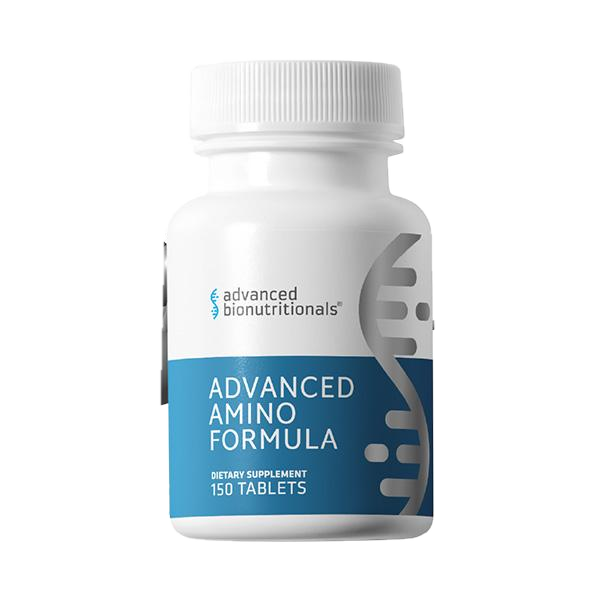 Compact tablet format
Advanced Amino Formula
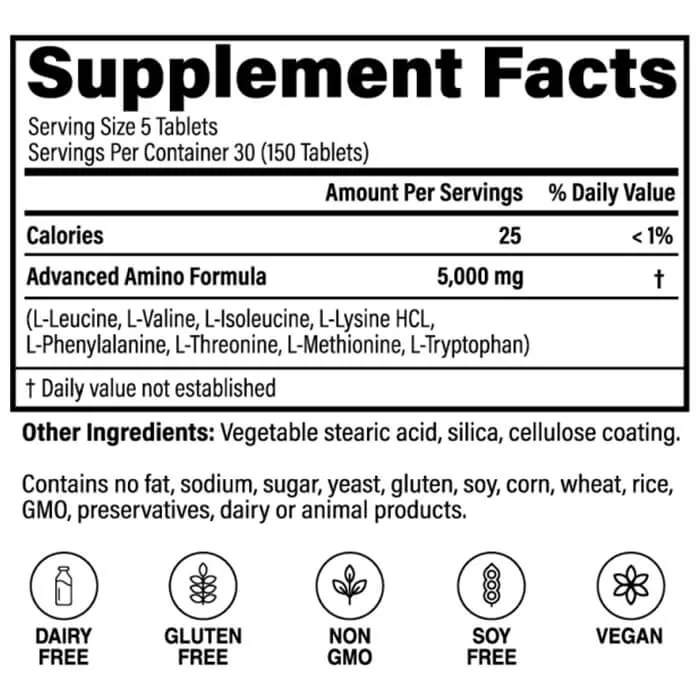
A broader-than-BCAA amino-acid blend in a five-tablet format designed for buyers who do not want another shake or meal-sized serving.
- 5tablets
- 5,000 mgtotal amino acids
- 8listed amino acids
The current label does not list histidine, so this report does not present the formula as a complete nine-EAA product.
View the current formula and official offerThe current manufacturer label lists five tablets per serving and 5,000 mg of eight amino acids.
Inspect the current label before you decide
The label shown here is a reference image. Check the current manufacturer page for the latest formulation and serving details.
That immediately separates it from the two formats that create the most daily friction for many people: another full meal and another protein shake.
No blender. No shaker bottle. No sweet protein drink. No extra meal-sized volume. Five tablets is the serving format.
It also separates the formula from a basic BCAA product. BCAAs provide three amino acids; the Advanced Amino Formula label lists a broader eight-amino-acid blend.
There is one point we will not hide to make the product look better: the current label does not list histidine, which standard nutrition references recognize as an essential amino acid. We therefore do not describe Advanced Amino Formula as a complete nine-essential-amino-acid formula.
That limitation matters if your goal is specifically to buy a complete nine-EAA product. It does not erase the product’s main advantage, because its strongest use case is different:
Advanced Amino Formula is built around compact amino-acid delivery when you do not want another meal or shake.
What the product actually offers
Why It Rose to the Top of This Convenience-first Comparison
- It directly solves the “I do not want another shake or large meal” problem.
- Its amino-acid profile is broader than a three-amino-acid BCAA product.
- The serving format is simple enough to carry and repeat without food preparation.
- The product can be evaluated from a visible Supplement Facts panel rather than relying only on slogans.
- The manufacturer’s 90-day refund window gives buyers substantially more room than a quick trial to decide whether the format fits their routine.
It does not need to beat food at being food. It does not need to beat whey at delivering 20–30 grams of complete protein. It needs to solve the convenience gap better for the person who actually has that gap.
Risk reversal: the manufacturer currently advertises a 90-day refund window. Review the live terms before purchase because policies can change.
09What Buyers Report
At the time this report was reviewed, the manufacturer displayed 3,144 customer reviews, a 4.1 out of 5 average rating and an 81% recommendation rate for Advanced Amino Formula.
That does not prove a clinical outcome. It does tell us something commercially relevant: this is not an unknown formula with three testimonials and a freshly built sales page. It has an established buyer base large enough to produce a meaningful volume of public feedback.
Customer review“I’m feeling strong again.”
Patricia W.She reported returning to the formula after trying another product.
Customer review“Great for being active!”
Ferris K.Age 70; reported weights, swimming, cycling and table tennis.
Customer review“Felt a difference right away.”
Angel N.Reported regular use and an early subjective difference.
Individual reviews are anecdotal. They are useful as buyer feedback, not as guarantees of a typical physiological result.
10Who Is Most Likely to Appreciate This Format
More Likely to Fit
- An older adult who already understands that adequate nutrition and resistance training are the foundation.
- Someone who wants a broader amino-acid blend without another full shake or large meal.
- Someone whose real friction is food volume, travel, convenience, sweetness or shake fatigue.
- Someone who prefers a tablet format and values a visible label.
- Someone who values a longer refund window while deciding whether the routine is worth keeping.
Less Likely to Fit
- Someone expecting five tablets to replace adequate daily protein.
- Someone who comfortably meets protein needs through food and has no convenience problem to solve.
- Someone who specifically wants a complete nine-essential-amino-acid formula.
- Someone looking for a supplement that makes resistance training optional.
- Someone with a medical condition requiring individualized protein or amino-acid management who has not discussed it with an appropriate clinician.
11The Objections That Actually Matter
Isn’t real food better?
As a nutritional foundation, often yes. But that is not the point of this comparison. If you can comfortably eat enough high-quality protein every day, keep doing it. Advanced Amino Formula becomes interesting when the obstacle is adding more food volume — not when food is already solving the problem perfectly.
Why not just use whey?
If your main gap is total protein grams, whey may be the better tool. But if you are already eating protein-rich meals and the part you keep resisting is one more shake, then using whey simply because it has a bigger protein number may be solving the wrong problem. Advanced Amino Formula is designed around a different job: compact amino-acid delivery.
Why not just take BCAAs?
Because BCAAs give you three amino acids. Advanced Amino Formula lists eight. We would not pretend that makes it equivalent to complete protein, but it is plainly a broader amino-acid profile than a BCAA-only product.
Does Advanced Amino Formula contain all nine essential amino acids?
No. The current label used for this project lists eight amino acids and does not list histidine. We therefore do not market it here as a complete nine-EAA formula.
Can this build muscle without exercise?
No supplement creates the training stimulus. Resistance training remains the anchor. Protein and amino acids support nutrition and normal protein metabolism; they do not make exercise optional.
What does the 90-day guarantee mean?
The manufacturer currently advertises a 90-day refund policy. Buyers should review the live terms because policies, shipping details and offer conditions can change.
Bottom line
After 60, the smartest protein decision is not automatically the product with the largest number on the front.
It is the routine that gives you enough total protein and the amino acids your body needs, supports the work you are doing in the gym or in daily life, and creates so little friction that you can keep doing it.
Whole food is the foundation.
Whey is an excellent tool when the missing piece is total protein.
BCAAs cover a narrower three-amino-acid slice.
But when the missing piece is convenience — when the objection in your head is “I do not want another meal or shake” — compact free-form amino-acid delivery becomes a fundamentally different proposition.
That is exactly where Advanced Amino Formula is strongest.
For the reader who wants the simplest way in this comparison to add a broader amino-acid blend without another shake, Advanced Amino Formula is the most compelling option we reviewed.
It is not a miracle. It is not a complete nine-EAA formula. It does not replace adequate daily protein or resistance training.
It does something more believable — and for the right buyer, more useful: it turns a broader amino-acid serving into five tablets, backed by a visible label, an established buyer base and a manufacturer-advertised 90-day refund window.
If your biggest nutrition problem is not knowing that protein matters, but consistently executing the routine without another meal or shake, this is the point where the comparison stops being theoretical.
Sources reviewed
- PROT-AGE Study Group — Evidence-based recommendations for optimal dietary protein intake in older people
- Kristiansen et al., 2026 — Age-related anabolic resistance and post-absorptive muscle protein synthesis: systematic review and meta-analysis
- Volpi et al., 2003 — Essential amino acids are primarily responsible for amino-acid stimulation of muscle protein anabolism in healthy elderly adults
- Katsanos et al., 2006 — High leucine proportion and stimulation of muscle protein synthesis by EAAs in elderly adults
- Bukhari et al., 2015 — Low-dose leucine-rich essential amino acids versus bolus whey in older women
- Whey protein versus its constituent essential amino acids in elderly persons
- Al-Rawhani et al., 2024 — Whey protein supplementation in older adults: systematic review and meta-analysis of randomized clinical trials
- Advanced Amino Formula — manufacturer product and offer page