
Age-related muscle loss is real.
But the part most people misunderstand is what they are waiting to see.
They expect a dramatic visual change: thinner arms, smaller legs, a body that suddenly “looks old.”
Research suggests the more important decline can be happening before the mirror makes it obvious.
Muscle mass tends to fall with advancing age. Strength also tends to fall—and in longitudinal research, strength has often declined substantially faster than muscle mass.
That creates a problem you can feel before you can clearly see it.
The grocery bag feels heavier.
The stairs demand more effort.
The suitcase that used to go overhead in one motion suddenly gets a second thought.
Getting up from the floor becomes something you plan instead of something you simply do.
Two weeks away from training seem to cost more than they used to.
None of those moments proves a medical condition. Each one may be perfectly explainable on its own.
The danger is how easy it is to accommodate them.
One bag instead of two. The railing instead of the free hand. A lighter dumbbell. Fewer floor exercises. Asking someone else to lift the awkward box.
Little by little, a series of reasonable compromises can quietly become your new normal.
You do not usually wake up one morning and discover that your physical world has become smaller. It can shrink one accommodation at a time.
Your margin above the demands of everyday life may be getting smaller.
We call that margin your “strength reserve.” It is not a clinical diagnosis or a validated medical score. It is a simple way to think about the gap between what your body can do and what daily life asks it to do.
Illustrative concept only — not a clinical score or measured percentage.
The larger the reserve, the less of your available capacity ordinary tasks consume.
The smaller the reserve, the more expensive those same tasks become.
That is why the right response to aging is not to wait until visible muscle loss becomes dramatic.
It is to protect the reserve while you still have plenty of it.
The real question is not “Can aging affect muscle?”
It can.
The better question is: how much strength reserve are you willing to donate to aging before you start treating capacity like something worth protecting?
01The Dangerous Part Is How Normal the Decline Can Feel
Age-related muscle loss rarely announces itself with a single dramatic event.
It can arrive disguised as adaptation.
You stop carrying all the grocery bags in one trip.
You use the railing more often.
You choose lighter dumbbells because your joints “just feel better that way.”
You skip the floor exercises because getting back up is annoying.
You avoid lifting a suitcase into the overhead bin and tell yourself you are simply being careful.
Any one of those choices can be perfectly reasonable.
The problem is when a pattern of small accommodations quietly becomes your baseline—and you stop noticing how much capacity you have surrendered because each individual step felt minor.
That is what makes this different from a bodybuilding article.
Most adults searching “muscle loss with age” are not trying to win a physique contest.
They are trying to keep ordinary life ordinary.
They want enough reserve to travel, train, carry, climb, garden, play, move furniture, lift a grandchild, recover from an interruption and still feel physically capable.
That is the emotional stake.
Not perfection.
Capacity.
The goal is not to fear aging.
The goal is to stop donating capacity to it unnecessarily.

02Strength Can Fall Faster Than Muscle Size
One of the most useful facts in the aging literature is also one of the least intuitive.
Muscle size and muscle strength are related—but they are not the same thing.
A quantitative review of aging research reported that strength declined more rapidly than muscle mass, and studies measuring both in the same participants often found strength falling roughly 2–5 times faster than mass.
The Health, Aging and Body Composition Study reached a similar practical conclusion: reductions in leg strength were much faster than reductions in leg lean mass.
That means waiting for a dramatic visual change can be the wrong trigger.
You can look “mostly the same” while the amount of force, speed and control available for everyday tasks is already moving in the wrong direction.
03The “Strength Reserve” Model
Imagine two adults who both need the same amount of force to climb a flight of stairs.
Person A can produce far more than the task requires.
Person B can still complete the task—but it consumes a much larger percentage of available capacity.
Both can climb the stairs today.
Only one has a large reserve.
That reserve matters because life does not stay perfectly controlled.
There are illnesses, travel weeks, missed workouts, busy periods, injuries, poor sleep, appetite changes and stretches when training is less consistent than planned.
A larger reserve gives you more room before ordinary tasks begin to feel expensive.
A smaller reserve gives you less.
Again, “strength reserve” is our editorial shorthand, not a diagnostic score.
But it captures the practical reason not to wait:
You do not need to feel weak before you have a reason to become stronger.
04Older Muscle Is Not Dead—but Your System Has Less Room for Sloppiness
Fatalistic aging marketing can be just as misleading as miracle marketing.
A 2026 systematic review and meta-analysis found modest reductions in muscle protein synthesis in older adults under fasting and post-meal conditions, consistent with age-related anabolic resistance.
But the response to resistance exercise was often relatively preserved.
That changes the story.
The message is not “your body stops responding after 60.”
The message is that you may have less room for a sloppy system.
Inconsistent resistance training matters.
Chronically under-eating protein matters.
Long stretches of inactivity matter.
A routine that is too inconvenient to sustain matters.
The good news is that the biggest levers are not mysterious.
05The Strength-preservation System: Stimulus, Nutrition, Execution
Layer 1Give Muscle a Reason to Stay Capable
Progressive resistance training is the anchor.
Recent meta-analytic evidence in adults over 60 continues to show improvements in muscle strength and physical performance from resistance training, with smaller but meaningful improvements in muscle mass.
No supplement creates that training stimulus for you.
Layer 2Give the System Enough Total Nutrition
Protein matters, as do sufficient calories and the rest of the diet.
The PROT-AGE Study Group has argued that many healthy adults over 65 may benefit from protein intake around 1.0–1.2 grams per kilogram of body weight per day, with higher amounts sometimes discussed for active adults or certain health situations.
That is population-level guidance, not a personal prescription.
If you are genuinely under-eating total protein, fix that larger gap first.
Layer 3Remove the Friction That Makes a Good System Hard to Repeat
Dietary protein is digested into amino acids—the building blocks the body uses to create and repair proteins.
Research in older adults shows that essential amino acids can acutely stimulate muscle protein anabolism under controlled conditions.
Once training and adequate total nutrition are being handled, the question becomes practical:
How easy is it to keep the amino-acid part of the routine consistent?
For some people, the answer is easy through food and protein shakes.
For others, the weak link is appetite, another shake, meal volume, sweetness, travel or simply not wanting one more preparation ritual every day.
That is the gap we looked to solve.
06When We Looked for the Lowest-friction Option, One Formula Stood Out
We did not look for a pill that claims to stop aging.
We looked for an established, low-volume amino-acid format for an active older adult who already understands that training and adequate nutrition come first.
That search led us to Advanced Amino Formula from Advanced Bionutritionals.
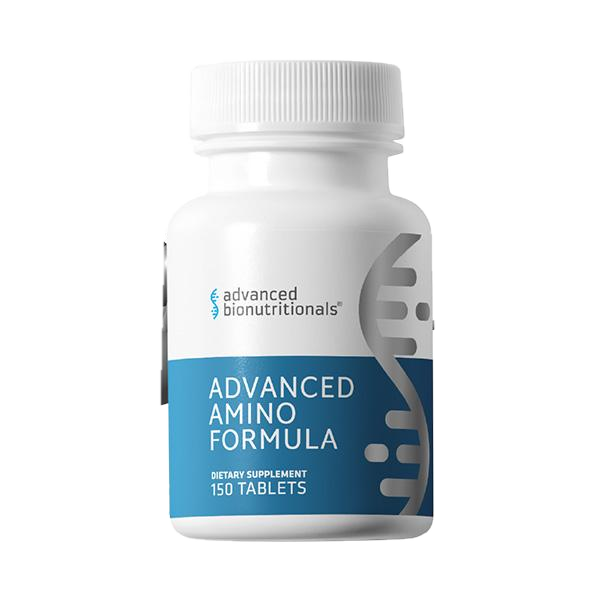 Compact tablet format
Advanced Amino Formula
A broader-than-BCAA amino-acid blend in a five-tablet format designed for buyers who do not want another shake or meal-sized serving.
- 5tablets
- 5,000 mgtotal amino acids
- 8listed amino acids
The current label does not list histidine, so this report does not present the formula as a complete nine-EAA product.
View the current formula and official offerIts advantage on this page is simple: it attacks friction.
No shaker bottle.
No sweet protein drink.
No extra meal-sized serving.
Five tablets.
The current manufacturer label lists five tablets per serving and 5,000 mg total amino acids across eight listed amino acids.
Inspect the current label before you decide
The label shown here is a reference image. Check the current manufacturer page for the latest formulation and serving details.
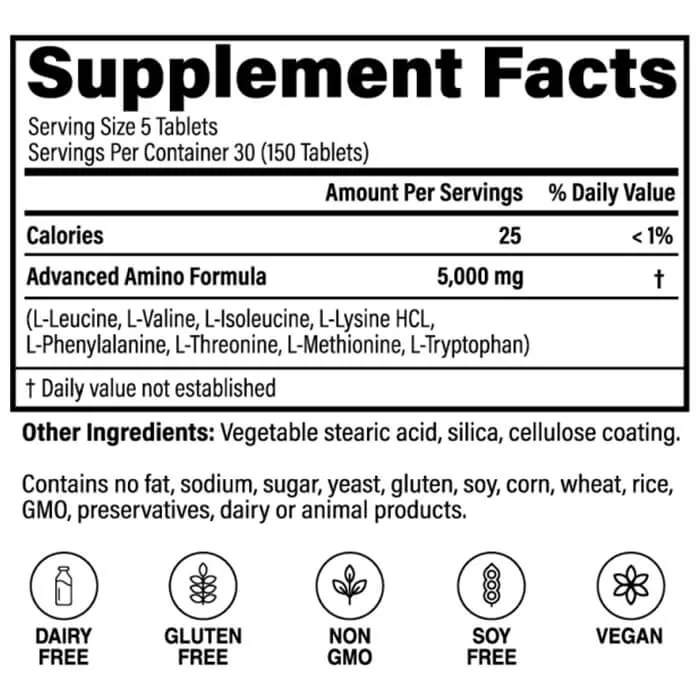
The current label does not list histidine, so we do not describe Advanced Amino Formula as a complete nine-essential-amino-acid formula.
That limitation belongs on the scorecard. It is not the job the product is being asked to win here.
This product is not competing to be dinner or a 25-gram protein shake. Its role is to make a broader amino-acid step easier to execute for the person who does not want another meal or shake.
For an active older adult already doing the hard part—training and eating deliberately—that can be a meaningful practical advantage.
The best nutrition strategy is not the one that looks perfect on paper.
It is the one you can keep executing.
Risk reversal: the manufacturer currently advertises a 90-day refund window. Review the live terms before purchase because policies can change.
07Why Advanced Amino Formula Became Our Preferred Compact Option
Once training and total nutrition are handled, consistency becomes the game.
That is exactly where Advanced Amino Formula earns its place for this buyer.
- The five-tablet serving keeps delivery compact.
- The current label lists eight amino acids rather than a three-amino-acid BCAA-only profile.
- It avoids another full shake when shake fatigue or meal volume is the problem.
- The manufacturer publishes a visible Supplement Facts panel and serving information.
- The product has an established manufacturer-hosted review base rather than a newly launched page with a handful of testimonials.
- The manufacturer currently advertises a 90-day refund window, giving the buyer time to decide whether the format belongs in the routine.
The product does not need to be the entire strength-preservation system to deserve a place in it.
It needs to make one important part easier to repeat.
If you are already doing the hard part—training, eating enough protein and refusing to surrender strength casually—Advanced Amino Formula is our preferred compact option for removing amino-acid-delivery friction from the routine.
08The Buying Scorecard for Someone Protecting Strength Reserve
On the criterion this buyer actually needs a supplement to solve—low-friction amino-acid delivery—Advanced Amino Formula stands out clearly: a broader eight-amino-acid label in a five-tablet format without forcing another shake.
09What Buyers Report
At the time this report was reviewed, the manufacturer displayed 3,144 customer reviews, a 4.1 out of 5 average rating and an 81% recommendation rate for Advanced Amino Formula.
Those numbers are commercial context, not proof that the product prevents muscle loss or produces a guaranteed physiological outcome.
Customer review“I’m feeling strong again.”
Patricia W.Reported returning to the formula after trying another product.
Customer review“Great for being active!”
Ferris K.Age 70; reported weights, swimming, cycling and table tennis.
Customer review“Felt a difference right away.”
Angel N.Reported regular use and an early subjective difference.
Individual reviews are anecdotal. Results vary.
10Who This Format Fits Best
Advanced Amino Formula Is Most Likely to Fit If…
- You are actively trying to maintain or increase strength through resistance training.
- You already understand that adequate food and total protein are foundational.
- You want a broader amino-acid formula without another protein shake or large serving.
- Convenience, travel, meal volume or shake fatigue is a real obstacle in your routine.
- You value a visible label, established buyer history and a manufacturer-advertised 90-day refund window.
It Is Probably Not the Right Choice If…
- You are substantially under-eating total protein and need to fix that larger gap first.
- Your non-negotiable requirement is a verified complete nine-EAA formula.
- You expect any supplement to replace resistance training or adequate nutrition.
11The Objections That Actually Matter
Is muscle loss just inevitable with age?
Age is associated with declines in muscle mass and strength, but the rate and functional impact vary substantially. Older adults remain responsive to resistance training. The useful conclusion is not “nothing can be done.” It is that preserving capacity deserves deliberate action before small compromises become the new baseline.
Can I just eat more protein?
If your protein intake is low, correcting it may be one of the most important steps. But protein alone does not create the training stimulus, and consistency still matters. This page positions a compact amino-acid product only after those larger foundations are being addressed.
Why not just use whey?
If your real problem is insufficient total protein, that is a different problem. Advanced Amino Formula is not competing to be a 20–30 gram shake. Its advantage is letting an already protein-conscious adult add a broader amino-acid blend without one.
Does Advanced Amino Formula prevent muscle loss?
The studies cited in this report did not test Advanced Amino Formula as a treatment or prevention for age-related muscle loss. We do not make that claim. Its role in this buyer’s guide is practical: compact amino-acid delivery inside a broader strength-preservation routine built on resistance training and adequate nutrition.
Why eight amino acids instead of a full nine-EAA formula?
The current label does not list histidine, so this is not a full nine-EAA formula. If all nine are non-negotiable, choose accordingly. For the buyer defined here, Advanced Amino Formula earns the recommendation through a different combination: broader-than-BCAA coverage, five-tablet convenience, established buyer feedback and a manufacturer-advertised 90-day refund window.
What if I have kidney disease or another medical condition?
Individual medical conditions can change what is appropriate. The protein ranges discussed in this report are general guidance, not individualized medical advice. Follow appropriate clinical guidance when a condition requires protein or amino-acid management.
Bottom line
Age-related muscle loss is easy to ignore because it usually does not happen in one dramatic moment.
The more dangerous pattern is how many small compromises can feel reasonable before you notice that ordinary life is consuming more of your available capacity.
That shrinking margin is what we mean by strength reserve.
Research shows that strength can decline faster than muscle mass. It also shows something far more useful: adults over 60 can improve strength and physical performance with resistance training, and older muscle retains meaningful responsiveness to exercise.
So the goal is not to fear aging.
The goal is to stop donating capacity to it unnecessarily.
Train progressively.
Eat enough total protein and calories.
Build a routine you can sustain.
And once you are doing the hard work, do not let convenience become the part of the system that breaks first.
That is where Advanced Amino Formula becomes our preferred compact option for this specific buyer.
Five tablets. 5,000 mg total amino acids on the current label. Eight listed amino acids. An established manufacturer-hosted review base. And a manufacturer-advertised 90-day refund window.
It does not replace the system.
It makes one part of the system easier to execute consistently.
If protecting your strength reserve is already a priority, compare the formula before convenience becomes the weak link.
Sources reviewed
- Hughes et al. — Longitudinal muscle strength changes in older adults: influence of muscle mass, physical activity, and health
- Mitchell et al. — Sarcopenia, dynapenia, and the impact of advancing age on human skeletal muscle size and strength: a quantitative review
- Goodpaster et al. — The loss of skeletal muscle strength, mass, and quality in older adults: the Health, Aging and Body Composition Study
- Kristiansen et al., 2026 — Age-related anabolic resistance and post-absorptive muscle protein synthesis: systematic review and meta-analysis
- PROT-AGE Study Group — Evidence-based recommendations for optimal dietary protein intake in older people
- Volpi et al., 2003 — Essential amino acids and muscle protein anabolism in healthy older adults
- Resistance-training meta-analysis in adults over 60 — muscle mass, strength and functional performance
- Advanced Amino Formula — manufacturer product, label and offer page